
Understanding EMDR Therapy: Stages, Benefits, and Readiness
June 21, 2025



What is EMDR?
Eye Movement Desensitisation and Reprocessing (EMDR) is a type of therapy used to reduce the amount of distress associated with a traumatic event, through re-processing the memories that are causing this distress. This re-processing is done through bilateral stimulation, where both sides of your brain are activated at the same time, whilst thinking about the memory. The activation of both of the brain’s hemispheres at the same time can be done through side-to-side eye movement. It has been designed for very traumatic events that have caused PTSD or complex PTSD.
What is the process of EMDR?
There are usually eight stages of EMDR, each being important to safe and effective therapy. Some stages are repeated each session as a core part of the therapy process; this tends to be stages 4-8. Other stages, such as 1-3, may take up the first few sessions, until you and the therapist feel ready to move on.
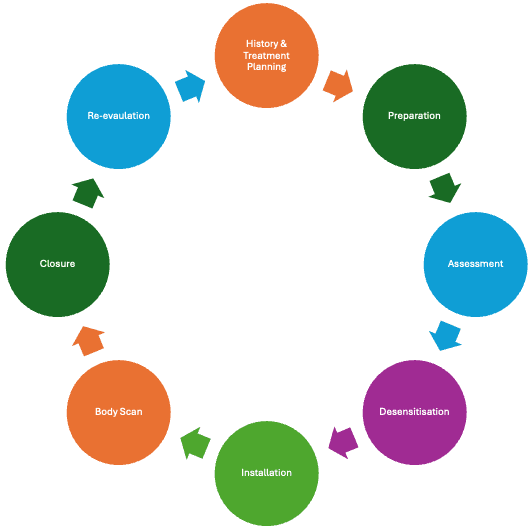
1. History and Treatment Planning
This is where you will discuss if EMDR is appropriate for you, and importantly, if you are ready. You and your therapist will consider numerous areas of your past and present life, such as risk factors, health and any ongoing legal issues. We will discuss signs that show if someone is not ready for EMDR later on in the article.
You will also look at your history, including what has caused the presenting issues in your life, specific triggers that maintain the issues, and what you would like your future to look like.
2. Preparation
This is an important phase where you build your relationship with your therapist. They will also explain more about EMDR, and it is a good time to raise any questions or concerns that you may have. The therapist will also talk to you about what techniques you have that help you cope when you are feeling distressed or other strong negative emotions. This is important as EMDR can cause these emotions to arise.
3. Assessment
The assessment stage is where you will think about how the memories of the traumatic event are impacting you. This may involve thinking about a strong memory to do with the event, any negative and positive thoughts that memory causes and the intensity of the thoughts and emotions associated with the memory. You may also think about where in the body you physically feel those emotions.
4. Desensitisation
This is where you think about and sit with the memories, emotions and thoughts from the traumatic event whilst doing eye movements or hand movements that aid the processing of memories. For example, this may include moving your eyes side to side. You will go back over these memories, emotions and thoughts in detail, and the therapist will guide you through this. This can be very distressing, and you will be able to stop at any time.
5. Installation
Installation is where you may start to feel as if change is starting to occur. This is where you reflect on the negative thoughts you used to think about the traumatic event, such as ‘this means I am useless and unsafe’, and you start to see if those thoughts seem as powerful. You may even start to think of more positive thoughts that are more reflective of what occurred, such as ‘this was not my fault’.
6. Body Scan
A body scan involves thinking of the traumatic memories and scanning your entire body to see the location of any physical feelings that come up. You will then work with your therapist to try to reduce this discomfort by using techniques used in stage 4.
7 . Closure
This important stage is where you return to a calm place in terms of your emotions, usually at the end of each session. Your therapist may introduce specific calming and regulating techniques to help with this or you may know some already.
8. Re-evaluation
This is commonly done at the start of each session, where you will review memories you previously went over to see if any of the benefits found have been maintained between sessions. Depending on the level of maintenance, the therapist may suggest moving on to new memories, or you may focus on the same memory again within the session.
What has EMDR been helpful for?
EMDR has been researched and found effective for children in helping with symptoms of:
- PTSD
- Anxiety symptoms
- Depressive symptoms
However, the general recommendation in the UK is that EMDR should only be used in children to help with mental health problems that stem from trauma.
What are the signs that someone is not ready for EMDR?
Sometimes people can think that EMDR is a quick and easy way to process difficult memories. This line of thought can underestimate the intensity of emotions that EMDR can bring up for people. Here are some signs that someone is not ready for EMDR.
You are not able to manage feelings of intense emotion
When people have been through significant trauma, sometimes dealing with emotions can be really challenging and triggering for them. EMDR, as outlined, can bring up quite big emotions, so having tips and techniques to help you manage these big emotions is essential for being ready for the therapy. If you do not have these tools and techniques, it might be worth reaching out to your GP for support to try and build those first before having EMDR..
You are going through a period of instability and/or stress in your life
Trying EMDR when there is instability and stress can cause it to become even more challenging, and you may find that you are unable to commit emotionally and in terms of time to the therapy. Things that may impact this stability are:
- Health issues
- Family changes
- Financial challenges
- Legal issues
You are reliant on drugs or alcohol
If you are using high amounts of drugs or alcohol and/or you are using drugs and alcohol to manage your emotions, this may suggest that now is not the right time for EMDR. Most therapists will recommend being sober for 24 hours before and after therapy to ensure the therapy is effective. Again, we recommend reaching out to your GP if you are struggling with this.
Certain medications
Certain medications for physical health and mental health can make the EMDR less effective, for example, Benzodiazepines. You can discuss this with your therapist in the first few sessions, who can advise you on the next steps.
Useful Links
EMDR UK
Has helpful information about EMDR, including the use of EMDR with children and adolescents.
PTSD UK
Has a brilliant and informative section about EMDR, including how to find an accredited therapist and an animation that can be used to explain EMDR to children.
Child Mind Institute
Discusses the use of EMDR in children and the role of parents while the child is having EMDR.